11 de octubre de 2026
Working Coffee Farm or Photo Stop? Judging Guatemala Tours
Four checks separate a working Guatemalan coffee finca from a staged photo stop: who picks, how long cherries sit, where roasting happens, and season.
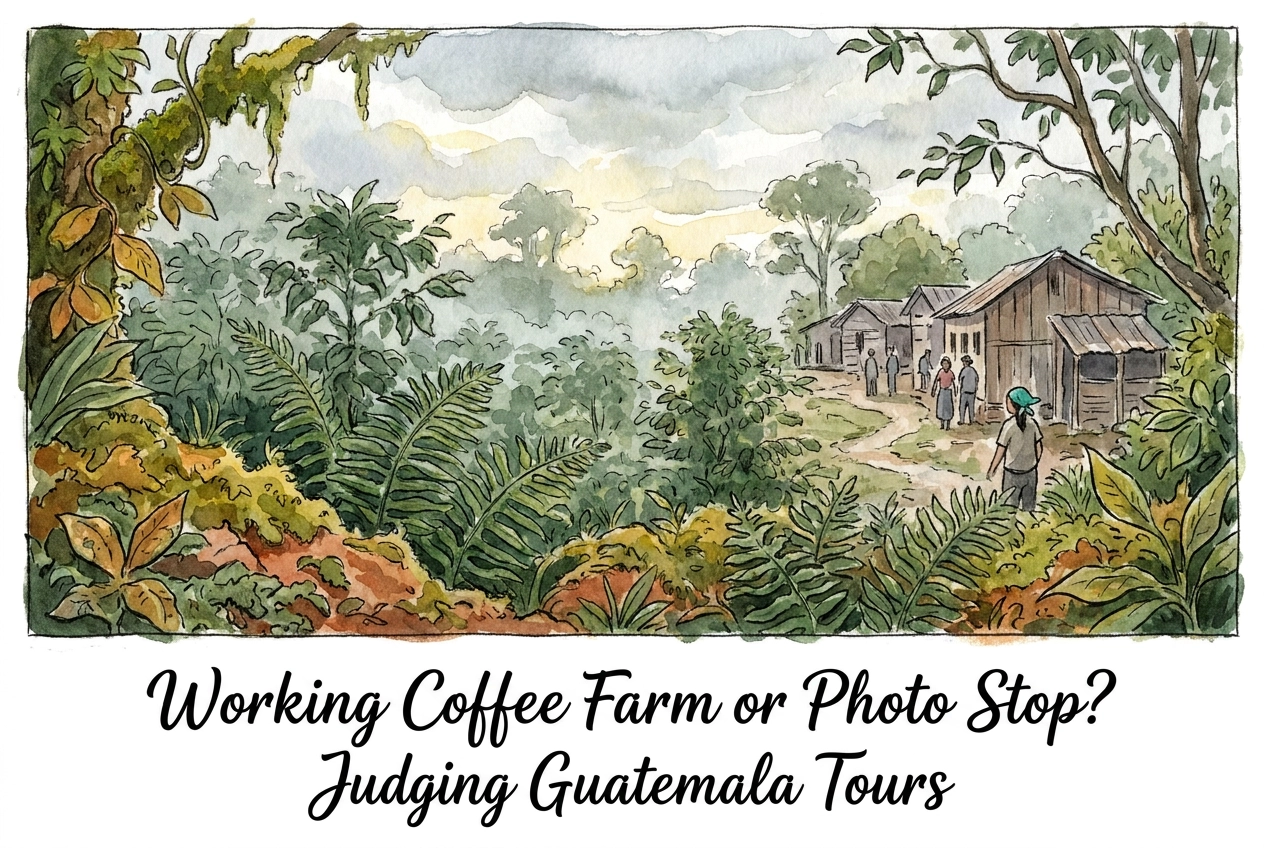
A coffee tour in Guatemala can be a genuine encounter with agriculture or a polished set piece with a few coffee bushes and a tasting bar. The difference matters because travel copy often uses la finca as loosely as it uses lodge or resort, even when the property is not a working agricultural holding. This guide gives you criteria to judge a plantation visit before you book it.
You will learn what la finca actually means and why the word gets borrowed. You will compare two archetypes: the working finca and the staged photo stop. Four practical tests follow: who picks the cherries and whether you can watch them; how long cherries sit before the pulper; whether roasting happens on site or merely on a display shelf; and whether the season is real or the tour is always available. We then give you an eight-sign red-flag checklist, show what a working multi-enterprise farm looks like, and explain how to book a Guatemala coffee tour in the right window. By the end, you can separate process from performance.
What la finca actually means, and why travel copy borrows the word
La finca is a working agricultural holding: land that produces a crop. It is not a synonym for a boutique lodge; travel listicles routinely lump fincas with haciendas, lodges and resorts, blurring the one word that should tell you whether a farm is functioning.
Scale matters. In Guatemala, 44% of coffee is produced by smallholders, and the sector employs over 125,000 families, identifiable people with names, working in plain sight.
Apply a three-question filter to any property using the label: what does it grow, who farms it, and what part of the process happens on this land? Vague answers mean the word is decoration.
Consider the stakes. Roughly 3 billion cups are drunk daily, and at least 100 million people depend on coffee cherries for a living. A visit that never shows you the labour behind those numbers is a visit to a film set.
This article supplies four verifiable markers, applied in order, that work on any Guatemalan tour you are offered, from Antigua day trips to highland farm stays.
The two archetypes: a working finca versus a staged photo stop
Working fincas and photo stops photograph alike. Four markers separate them.
Marker | Working finca | Staged photo stop |
|---|---|---|
Who picks | Named seasonal crews, selective hand-picking, in plain sight | No crew or weighing point; a basket set aside for posing |
Cherries to pulper | Within hours, into a mill and drying area you walk through | No pulper, no drying patio, no time quoted |
Roasting | Own crop roasted on site; green coffee stored; lots identified | Decorative grinder, tasting room, bags bought in |
Season | Tour calendar follows the harvest, so dates move with ripening | Bookable year-round; season never mentioned |
A working finca runs on the standard cherry-to-roasted-bean chain, and its guides give numbers and dates because they live with them. A photo stop runs on narration recalled from memory.
Be fair: a photo stop can be a pleasant morning with a decent cup, and it genuinely teaches you what a coffee plant looks like. It just cannot show agriculture, which is what the marketing promises.
Operators increasingly use phrases like "field to factory" and "hands-on process tour." Treat those as claims to verify, not proof.
Test 1: who picks the cherries, and can you watch them do it?
Ask three questions before booking: who harvests the coffee here, are you picking this week, and can we walk out to where the crew is working? A working finca answers immediately. A staged operation deflects to the tasting room.
On quality-focused farms, cherries are hand-picked at peak ripeness, red-purple and firm. Ask whether the farm selects by ripeness or strips whole branches; the distinction signals how seriously it treats quality.
On site, look for collecting baskets or sacks, workers moving in rows, a weighing point and a tally sheet. Ask how pickers are paid and whether crews come from the surrounding community. Yet farmers capture less than 10% of the final market value of their crop.
Then watch for the tourist-picking trap. A basket set aside so visitors can pose proves nothing. Real picking follows ripeness, weather and altitude, not tour bookings. Any tour that never names who does the work is hiding the supply chain's most important link.
Test 2: how long do cherries sit before they reach the pulper?
Once you know who picked, ask the clock question: "How many hours between picking and processing today?" A real working finca answers with a number, often the same day, because fruit starts fermenting the moment it leaves the tree. Delayed pulping lets mucilage break down, generating heat and sour, discoloured beans. Vague replies about careful handling, with no timeframe, are a soft red flag.
To verify the answer, ask to walk the route. You should see a pulper, fermentation tanks or washing channels, and a drying area: a concrete patio or raised beds. Viewing from a balcony does not count. If cherries or parchment leave for a shared co-op mill, that is legitimate, but the property is not field-to-factory and its marketing should say so.
At the receiving area, use your nose. Ripe cherry smells like fresh fruit. A sharp, vinegary note can suggest fruit has sat too long, a practical field check, not a certified standard. Finally, get specifics on drying. Sun and mechanical drying, and their duration, shape flavour. A farm that controls these choices can explain them in detail, not slogans. Roasting is the next test.
Test 3: does the roast happen here, or is it a display shelf?
Roasting is the next link. Ask to see the roaster working, not standing as furniture. In most producing countries, coffee leaves as green or parchment and is roasted near the consumer; certificates of origin follow the export form, not the cup. That chain is legitimate; it is not a farm-roastery tour.
The distinction that matters: we roast coffee we buy versus we roast coffee we grow. Only the second closes the loop from plant to cup.
Request verifiable details: check whether bags carry lot identification and a roast date, look for green coffee in storage, and ask whether there is a cupping table. A farm that cups its own lots can defend its flavour claims; sensory analysis remains the benchmark for quality and origin. Tasting several lots from one farm shows whether the operation understands its own variation across plots, altitude and processing.
A roastery alone proves nothing about agriculture. A city café with a drum roaster can deliver a compelling experience with no farm, no crew and no harvest. Apply it alongside the other three.
Test 4: is the season real, or is the tour always available?
A working roastery proves a business cares about coffee; only harvest proves the coffee is grown there. Guatemala's crop comes off in the drier months, roughly late November through March, with the window shifting by altitude and region. A tour sold year-round is, most of the year, a tour outside harvest.
Ask for the farm's own picking calendar and set it against its elevation. Altitude affects ripening pace, so confirm picking dates directly with the specific finca rather than relying on a generic national calendar. Altitude is also the quality claim Latin American farms lead with, because slow ripening concentrates flavour. Ask what elevation the plots sit at and how it shapes both picking dates and cup profile.
Off season you still see real agriculture: flowering after the first rains, green cherries, pruning, shade management and nursery work. Worth seeing, if labelled honestly. Guatemalan growers contend with rust, shifting rainfall and a replanting backlog: over 125,000 families depend on the crop, and much of the coffee land still needs renewal. A farm that discusses those is a farm living with them.
The red-flag checklist: eight signs of a staged coffee tour
Use this checklist before you book, not after you arrive. Most of it can be verified in a single email.
No mill, no pulper, no drying area. If none of these exist anywhere on the property, a "plant to cup" claim is marketing, not agriculture.
Harvest advertised year-round. Guatemala's picking window is seasonal. A booking calendar that never mentions picking dates, elevation or ripening is selling a set, not a farm.
A "roastery" that is really a shelf. Branded bags with no green coffee in storage, no roast dates and no lot information signal retail, not roasting.
Staged picking. A pre-picked basket held aside for photos proves nothing. Nor does a guide who cannot name the varietals grown on the property or the elevation of the plots.
No visible crew. Look for a named picking team, a weighing point, tally sheets. Then ask who harvests, how they are paid and where they come from. Refusal to discuss labour is the loudest red flag of all.
Coffee sold without identity. A bag carrying a brand but no farm, plot or lot name usually means the beans were bought in through intermediaries rather than grown on site.
A route that avoids work. Paths, terraces and viewpoints only, with no entry into a working building, fermentation tank or drying patio, is a garden tour.
Warmth without numbers. Birdsong, home cooking and family stories are lovely; they are not verification. A working farm can supply dates, hours, elevations and process detail on demand.
One flag alone may be innocent. Four or five together describe a photo stop.
What a working multi-enterprise farm looks like in practice
A genuine finca rarely survives on one crop. Travel listicles flatten this into accommodation plus a tour; in reality the tour is incidental to an operation that already earns from agriculture.
Casa Misterio Verde, near San Cristóbal Verapaz, shows the layered model. Coffee grows alongside a working ranch with horses for hire, and cabins, a hotel, a restaurant and event venues sit within the same landscape. That structure is also why now is the moment to visit Casa Misterio Verde.
Use it as your diagnostic. Ask whether the property's income comes from the land or from visitors. On a multi-enterprise farm, cabins and meals are add-ons to something that already exists. On a photo stop, the tour is the product.
Elsewhere, a 30-acre organic Costa Rican farm (Finca Rosa Blanca) illustrates how much process detail a real operation can supply to visitors.
So ask each tour what else the land produces. That answer tells you more than any booking-page photo.
How to book a Guatemala coffee tour in the right window
Plan the trip around harvest, not flights, it is the only window when all four tests are live simultaneously.
Ask this script by email: What is being picked this week? How many hours from picking to pulping? Is there a mill and drying area on site? Do you roast your own crop? What elevation are the plots?
Pair the field walk with a cupping session, so the tasting maps back to plots, processing and roast you just saw.
Altitude affects ripening pace, so confirm picking dates directly with the specific finca rather than relying on a generic national calendar.
Off season? Ask honestly for a flowering, pruning or nursery visit plus a mill walkthrough. Save the full harvest tour for a return trip.
Judging a Guatemala plantation tour: the short version
Once you have your dates, judge any tour by four tests, in this order: who picks the cherries and can you watch them? How many hours pass between picking and the pulper? Does the roast happen on site with the farm's own crop? And does your visit fall inside the real harvest window?
Vague answers are answers, a working farm quotes numbers on demand.
You are not paying for a cup in a pleasant setting. You are paying to see how 3 billion daily cups begin: labour, timing and weather, all visible only in season.
Conclusion
Email the finca today, ask for the picking calendar and three honest answers about mill, roast and elevation. Book the tour that can answer all four tests in season. That is where the cup and the labour finally meet.