5 de octubre de 2026
Verapaz, Antigua or Atitlán: choosing where to base a nature stay in Guatemala
Compare Verapaz, Antigua and Atitlán on terrain, climate and crowds, then pick the base that fits your nature stay in Guatemala.
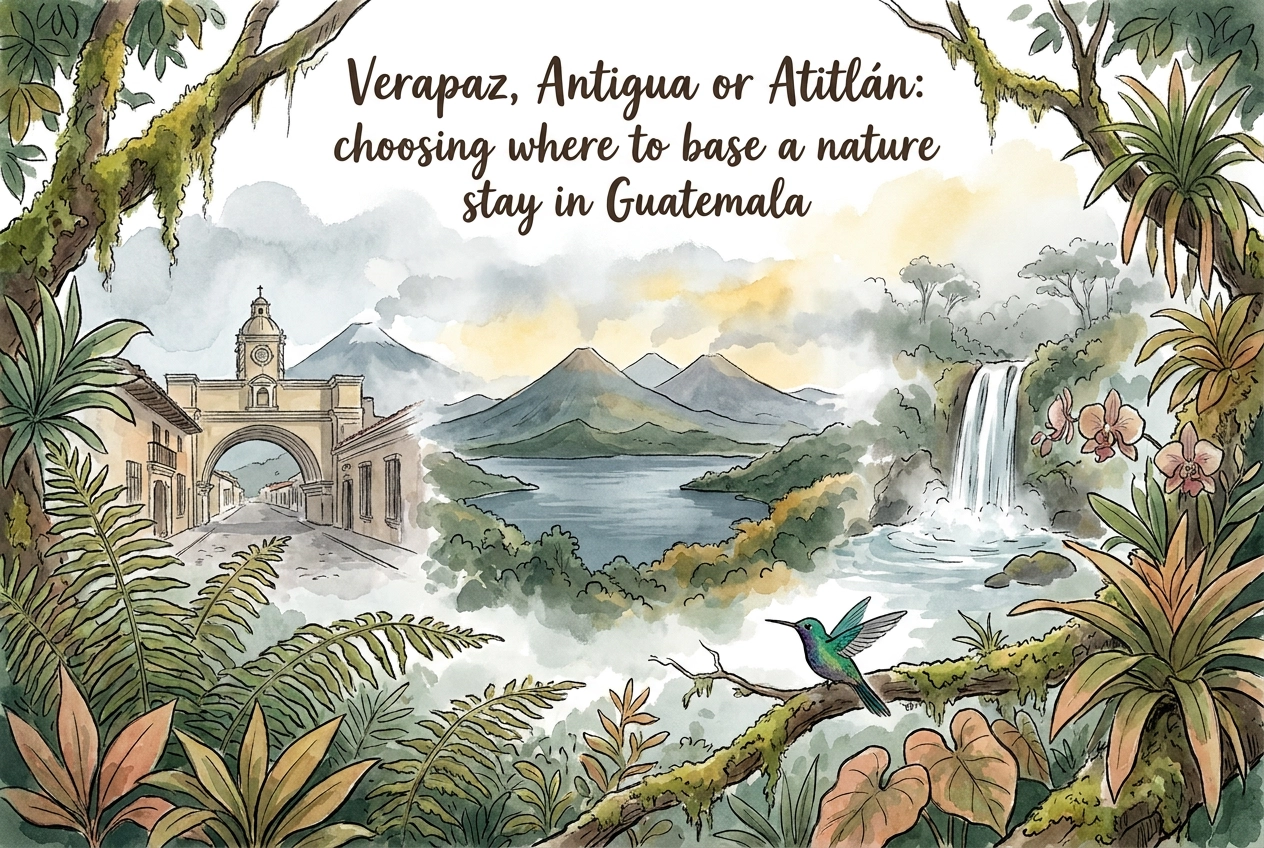
Most travellers pick where to sleep in Guatemala the way they pick a photo: Antigua or Atitlán, whichever shows up first. Then they plan the trip around the bed. That is backwards. Where you sleep decides how far you drive, what weather you wake up to, and how many other people are standing in your view. This post treats lodging as a routing decision, not a booking detail.
We compare three bases: San Cristóbal Verapaz, Antigua Guatemala, Guatemala's most polished colonial town, and Lake Atitlán, its most photographed lake. Antigua wins on logistics and colonial atmosphere. Atitlán wins on volcano views, and also on crowd density. Verapaz wins if you want cloud forest, a working farm and fewer people in the frame, and you accept that getting there needs a contingency plan.
You will read a side-by-side glance, then terrain and climate, distance from mass tourism, transfers and road time, and what regional safety guidance actually says. There is also a self-selection matrix, so you can match your trip type to a base before you shop.
Where You Sleep Is a Routing Decision, Not a Booking Detail
Where you sleep sets your daily radius, your weather, your crowd density and your transfer times. It does the routing long before a room review matters.
Antigua and Atitlán are the default answers for Guatemalan lodging because they are well known, well served and heavily marketed. That is also why they hold the most travellers.
Verapaz is the third answer, and it suits a specific kind of traveller: cloud forest, a working farm, fewer people in the frame. Guatemala's tourism push is drawing more visitors, so curious travellers are already looking past the classics, which is why now is the moment to visit Casa Misterio Verde.
One routing fact worth knowing: the UK FCDO advises against all but essential travel to parts of Guatemala, not the whole country, so risk is geographically partial. Check current guidance before you travel.
This is a self selection guide, not a ranking. The right base depends on the trip you are actually taking.
Verapaz vs Antigua vs Atitlán at a Glance
Antigua and Atitlán are Guatemala's headline draws, named as the drivers of a visitor surge; Verapaz sits outside that circuit entirely.
Antigua | Atitlán | Verapaz | |
|---|---|---|---|
Terrain | Highland valley ringed by volcanoes | Volcanic lake basin, 1,500 metres | Karst hills, cloud forest, coffee country |
Climate | Dry and temperate | Mild days, cooler nights | Humid and misty, more rainfall |
Tourism density | High | Very high in main villages | Low |
Transfer reality | Easy road access from Guatemala City | Winding lake road and boats | Longer overland transfer |
Best suited trip | Short trips, first visits | Lake scenery, village hopping | Nature, farms, horses |
Verdict | Easiest logistics, most crowds | Best views, boat dependent | Fewest people, longest journey |
Rainfall and temperature shift sharply with altitude, so check Guatemala's climate data for your month rather than trusting a dry season average.
Now for the why behind each verdict, starting with Antigua.
Antigua Guatemala: The Colonial Base With the Best Logistics
Antigua sits in a highland valley ringed by volcanoes, with a walkable grid of cobblestone streets and day trips to Pacaya and Acatenango on the doorstep. The climate is temperate and relatively dry: cool mornings, warm afternoons, low humidity. If damp air is your enemy, this is your base.
That comfort explains the density of Antigua Guatemala alojamiento, from hostels to boutique hotels. Demand keeps climbing, with Guatemala closing 2025 up 11% in visitor arrivals, so more beds mean sharper competition on price and better last-minute availability, but also higher peak-season rates and street noise if you book near the centre.
Be honest about the trade-off. Antigua is the most photographed and most crowded of the three, so a nature stay here means commuting to nature, not sleeping inside it.
It suits first-time visitors, short trips, language students, and anyone who wants restaurants and transport on the doorstep. Next, Atitlán, where the logistics get more scenic and more complicated.
Lake Atitlán: Volcano Views and the Highest Tourism Density
If Antigua's cobblestones and easy logistics appeal, Atitlán trades some of that convenience for one of Central America's great views. The basin is a caldera lake at roughly 1,500 metres, with three volcanoes on the skyline and villages strung around the shore. Days stay mild and spring-like most of the year, nights cool, afternoons bring wind on the water, and rain concentrates in the wet season.
Routing here is different. Villages are reached by boat or a slow, winding road, so your base shapes daily logistics more than in Antigua. Panajachel and San Pedro see the heaviest footfall; quieter north shore villages trade convenience for calm.
It suits scenery-first travellers, hikers, yoga and wellness stays, and anyone happy to plan around boat schedules. If that sounds like admin you would rather skip, the cloud forest around Verapaz may fit better.
San Cristóbal Verapaz: Cloud Forest, Working Farms and Fewer People in the Frame
Where Atitlán offers a view, Verapaz offers a texture: karst limestone hills, deep green valleys, rivers, coffee slopes and cloud forest at noticeably lower tourism pressure than the classic circuit. Alta Verapaz is one of nine priority areas in Guatemala's national biodiversity strategy, and its cloud forests sit largely unprotected (Community Cloud Forest Conservation).
The climate runs humid and green, with mist drifting through the trees, cooler air at elevation and a wet season that shapes both your packing and your timing.
Stays here are farm-based rather than a street of competing hotels: cabins, coffee plantation walks, horses for hilly ground, long meals. Search for Guatemala's travel wonders and you will find Antigua, Chichicastenango, Quetzaltenango. Verapaz is absent, which is exactly why it feels uncrowded.
It suits travellers who treat nature as the destination, photographers, slow travellers, families wanting space and anyone allergic to tour buses. See Casa Misterio Verde for the kind of stay this means, or read about the farm.
Terrain and Climate: How Altitude and Rainfall Change the Trip
That green comes from a specific climate, and altitude sets the baseline. Antigua and the Atitlán basin both sit around 1,500 metres, keeping days mild and nights cool. San Cristóbal Verapaz mixes warm valley floors with cooler, damper forest slopes, so temperature tracks elevation as much as season. Humidity and cloud cover are the real differentiator: Antigua is drier and clearer, Atitlán adds afternoon wind on the water, and Verapaz stays misty and humid, which is the point rather than a drawback.
For rainfall, skip generic wet season claims. INSIVUMEH publishes station-level rainfall and temperature data, so pull normals for the station nearest your base, whether that's Cobán, Antigua or Panajachel, then check your specific travel month. A dry season average can still hide a wet week.
Pack for that: layers and a rain shell everywhere, plus sun protection at altitude. Antigua rewards sturdy shoes for cobblestones, Verapaz needs footwear that handles mud, and Atitlán calls for a windproof layer on boat crossings.
Distance From Mass Tourism: What Fewer People in the Frame Actually Means
Terrain and rainfall set the stage. Crowd density decides who else is standing on it.
Distance from mass tourism is not kilometres from a city. It is how many other travellers share your viewpoint at 9am. In Antigua, that number spikes around the plaza, the arch and the volcano trailheads. Atitlán concentrates crowds in Panajachel, San Pedro and the main boat docks, especially mid-morning. Verapaz works differently: the landscape itself is the attraction, so there is no single square or viewpoint where everyone funnels.
For a rough proxy, check INE Guatemala population density for built-up versus open country, then INGUAT visitor statistics to see where arrivals cluster.
Low density has a trade-off. Fewer restaurants, fewer English-speaking services, and transport you arrange in advance rather than improvise.
Here is the test: do you want to be near things to do, or inside the thing you came to see? Antigua and Atitlán win the first. Verapaz wins the second.
Getting There: Transfers, Road Time and Why Verapaz Needs a Contingency Plan
Soft travel means fewer people, but it also means fewer alternatives when the road misbehaves. Antigua is the shortest run from Guatemala City, usually a straightforward highway transfer. Atitlán adds a winding descent to the lake, so budget more time than the distance suggests. Verapaz is the longest leg: an overland push into the highlands, best done in daylight with a driver who knows the route.
The UK FCDO notes that strikes and large demonstrations can occur with little or no notice, that most are peaceful, and that they can still disrupt transport. Check current guidance before travel. Blockades matter more for Verapaz, because a closed highway leaves you further from the tourist core than someone based in Antigua.
So plan around it: keep a buffer day before your flight, carry a cash reserve, confirm road conditions with your accommodation the day before, and skip tight same-day connections. Book somewhere that arranges private transfers and gives local advice, rather than improvising on arrival.
Safety and Access: Read Regional Guidance, Not Country Headlines
Now that transfers are sorted, the safety question is simpler than headlines suggest. The UK FCDO advisory warns against all but essential travel to parts of Guatemala, not the whole country (check current guidance before travel). Risk is mapped by region, so open the FCDO regional risks page. Verapaz, Sacatepéquez (Antigua) and Sololá (Atitlán) each carry their own entry and deserve reading separately.
Don't let fear lead. The same guidance notes there's no recent history of terrorism in Guatemala, though attacks cannot be ruled out. Civil unrest, strikes and demonstrations are the documented local concern, and most stay peaceful.
Turn that into behaviour: book registered shuttles or private transfers for after-dark legs, keep valuables out of sight, and ask your host about specific trails rather than guessing.
One last thing: advisories shift. Check guidance close to departure, not months out, and treat it as live rather than fixed. With that checked, the base decision becomes a matter of fit.
Self Selection Matrix: Match Your Trip Type to Your Base
Safety sorted, the rest is fit.
Trip type | Best base |
|---|---|
First time visitor, short trip, colonial architecture, services | Antigua |
Scenery chaser, boat travel, wellness, village hopping | Atitlán |
Hiker, photographer, slow traveller | Atitlán for volcano trails, Verapaz for cloud forest |
Family, remote worker, event or retreat group | Verapaz |
Coffee, farm life, horse riding, quiet | Verapaz |
Combining works well: two nights in Antigua for arrival and orientation, then a longer Verapaz block as your deep nature stay. Treat Verapaz as the main event rather than a day trip, because the transfer alone will eat your daylight.
Where Verapaz Fits If You Want Cloud Forest and a Working Farm
If the matrix sent you to Verapaz, here is what that base looks like in practice: cabins and a hotel room set among green, a restaurant serving meals you did not have to plan, and event venues for groups who want the same quiet.
It is a working landscape, not a staged attraction. The coffee plantation is farmed, and walks link forest, cultivation and wildlife in a single loop. Horses are the practical bit. In hilly, humid terrain, walking is slower than the map suggests, so a ranch with horses for rent covers ground you would otherwise skip.
Compare that with a street of competing hotels and you get the trade: fewer places to eat, and fewer people in every photograph. Nuestras cabañas and tu lugar para hacer una pausa describe the shape of a stay here. If nature is the destination rather than the day trip, that is the whole point.
Choose Your Base Before You Shop
If that farm stay sounds like your trip, the final decision is simpler than a hotel shortlist. Terrain, climate and crowd density decide your trip more than any room upgrade.
Antigua delivers logistics and colonial comfort. Atitlán delivers lake scenery and village hopping. Verapaz delivers cloud forest, farm life and low tourism density.
Before opening a booking site, write down your top three priorities and match them to the self-selection matrix above. Then check current FCDO regional guidance for Verapaz, Sacatepéquez and Sololá, and confirm transfer times and road conditions before locking dates. If nature, coffee country and fewer people in the frame won your comparison, plan Verapaz as your main base rather than an add-on. Look at cabins, farm stays and restaurant options near San Cristóbal Verapaz, then book the stay that fits the trip you are actually taking.
Conclusion
Choosing where to base your Guatemala nature stay is a routing decision that shapes every day. Antigua gives you colonial comfort and the easiest logistics. Atitlán gives you volcano views and lively villages, with higher tourism density. Verapaz gives you cloud forest, working farms, and fewer people in each photograph. Terrain, climate, transfer time, and regional guidance matter more than a room upgrade.
Before you book, write your top three priorities and match them to the self-selection matrix. Check current FCDO guidance, confirm road conditions, then reserve cabins or a farm stay near San Cristóbal Verapaz if nature, coffee country, and quiet win. Your base should serve the trip you actually want. Choose it first, then let the rest of your itinerary fall into place.